
Freight Claims Process
 Roeslan Ozdoyev6 min read
A freight claim is a formal request for compensation when cargo is lost, damaged, or delivered short while in the carrier’s care. In practice, many claims are won or weakened at the receiving dock, not weeks later, because the delivery inspection, the notes on the proof of delivery, and the first photos often become the core evidence. Below, we break down the practical process: what to do at delivery, which documents to collect, which deadlines matter, and why some claims are only paid in part or denied.
Start at delivery: protect the claim before you sign
- Inspect the freight before signing anything. Check the piece count, pallet count, labels, and visible condition against the bill of lading and the delivery receipt. A clean signature can make it much harder to prove that damage, loss, or shortage happened in transit.
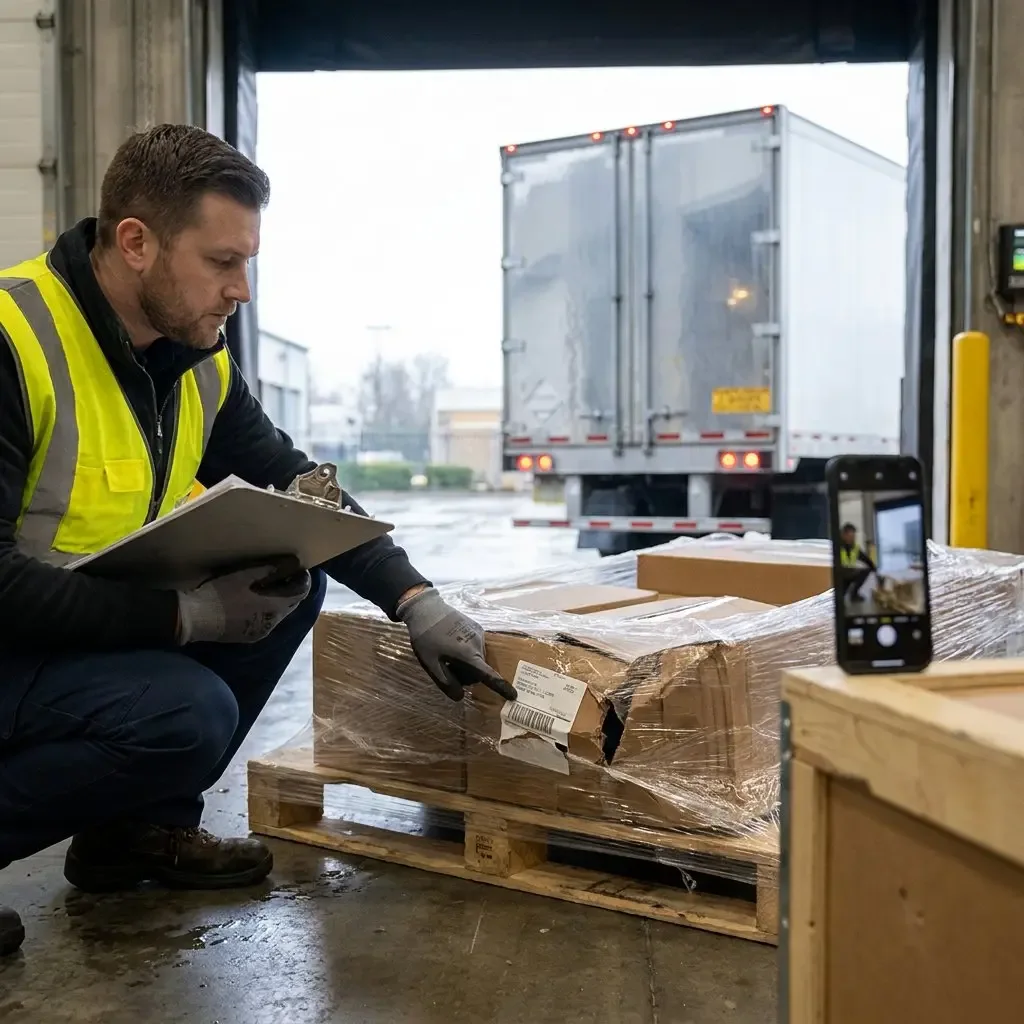
- Record exceptions on the proof of delivery immediately, even if the driver is in a hurry. Keep the wording factual and specific, such as “1 carton crushed,” “top pallet leaning,” “2 pieces short,” or “packaging wet on right side.” Vague notes like “subject to inspection” usually carry less weight.
- Take photos before the freight is moved or unpacked. Capture the full pallet, outer packaging, stretch wrap, labels, skid condition, seals if relevant, and close-ups of the exact damaged area. If there is a shortage, photograph the received freight and any labels showing what did arrive.
- Refusal can make sense when visible damage is severe enough that the goods appear unusable or the shipment cannot be checked safely. If only part of the freight is affected, it is often better to accept the usable portion, note the exact damage or shortage, and avoid rejecting sound product unnecessarily.
Match the problem to the right claim type
Claim type | Usually discovered | Best first response |
|---|---|---|
Visible damage | At delivery, before or during unloading | Inspect before signing, note exact damage on the POD, photograph packaging and product, and keep the affected freight available for review. |
Concealed damage | After delivery, once cartons are opened or inner product is checked | Report it under the applicable rules as soon as it is found, keep all packaging, stop disposal, and request an inspection if needed. |
Shortage | At delivery when the count does not match, or during unloading of mixed freight | Verify the count before signing, note the exact missing pieces, retain labels and count records, and accept the rest if it is usable. |
Total loss | When the shipment never arrives, is confirmed missing, or cannot be recovered | Confirm shipment history, gather the booking and freight records, and submit a formal written claim with proof of value and the claimed amount. |
Partial damage and partial shortages should be handled the same way: identify the affected units precisely and avoid rejecting good freight without a reason. Concealed damage is usually the hardest category because the shipment may have been signed for before the issue became visible.
Build the document pack before you file
Document or proof | Why it matters | When to include it |
|---|---|---|
Bill of lading | Shows what was tendered for carriage | Core record |
Delivery receipt or POD | Shows what was delivered and whether exceptions were noted | Core record |
Carrier PRO number or freight bill | Links the claim to the carrier’s shipment file | Core record |
Commercial invoice | Supports cargo value | Core record |
Claim amount calculation | States exactly what reimbursement is requested | Core record |
Photos, count checks, inspection reports, repair or replacement estimates | Strengthens proof of damage, shortage, and quantum | Include when relevant |
Salvage records or special regulated-goods documents | Supports unusual handling, disposal, or compliance facts | Only for special cases |
A complete first submission usually speeds up review. It reduces back-and-forth, gives the carrier less room to say the file is incomplete, and helps preserve a clean record if the claim later becomes disputed.
Don’t miss the deadlines that control the claim
Milestone | Timing priority | What to know |
|---|---|---|
Delivery-day exception note | Immediate | Visible damage or shortage should be noted before the POD is signed, because a clean receipt can seriously weaken the file. |
Notice of concealed damage | Very short | Hidden damage often must be reported quickly under the applicable contract, tariff, or mode rules, so do not wait until a full internal review is finished. |
Formal written claim | Longer, but still controlled | Many road-freight claim frameworks provide at least a nine-month filing window, but that is not universal. Always check the governing terms for the shipment. |
Carrier acknowledgment and investigation | After filing | Expect receipt confirmation, document requests, possible inspection, and then status updates or a decision based on the rules that apply to that movement. |
Lawsuit or formal legal action | Separate deadline | The time to sue is not the same as the time to file the claim. Missing that later window can end recovery even if the claim itself was filed on time. |
The key distinction is this: some steps are operationally urgent even when the legal filing period is longer. Also remember that contracts, tariffs, conventions, and service terms can change the process, especially for concealed damage, international moves, and different transport modes.
Know who is liable, what coverage applies, and how mode changes the rules
A freight claim, or shipping claim, is a request for compensation under carrier liability rules when cargo is lost, damaged, or delivered short in transit. It is not the same as a cargo insurance claim. A carrier claim depends on the shipping documents, the transport terms, the route, the mode, and the legal framework that governed the movement. Cargo insurance may respond differently and can cover losses that carrier liability does not, subject to the policy wording.
It is also unrelated to making a car insurance claim in the UK or any other motor policy claim. Freight commonly moves by road, rail, ocean, and air. The claim logic is similar across all four: show what was handed over, what went wrong, and the amount being claimed. But the liability rules, notice periods, package limits, and defenses can vary sharply by mode and by who physically carried the cargo, as well as the freight forwarder, carrier and customs broker roles involved. For example, U.S. domestic ground freight often refers to Carmack principles, yet even there recovery may be limited by released-rate terms or other agreed liability limits. That is why reimbursement does not always equal the shipper’s full business loss. Lost profits, production disruption, and customer knock-on costs often sit outside standard carrier payment.
How the claim moves from filing to resolution
Once the claim is submitted, the carrier reviews the file, confirms receipt in many cases, and checks whether the paperwork is complete. If the record is weak, the carrier may ask for missing documents, clearer photos, proof of value, or an inspection. During this stage, keep the damaged goods, inner packaging, pallets, and any salvageable product available until the inspection or salvage decision is finished, unless safety, contamination, or regulatory requirements require a different action.
From there, the claim may end in full payment, partial settlement, a negotiated compromise, or a denial. Read any release or settlement document carefully before accepting payment, because cashing out can close the matter. In the freight claims process, steady written follow-up helps prevent the file from stalling.
Why freight claims get denied - and how to reduce the risk
- Some denials are procedural. Common triggers include late filing, late notice on concealed damage, a clean POD with no exceptions, and an incomplete claim package.
- Others are liability disputes. The carrier may argue poor packaging, a break in custody, no proof that the goods were tendered in good condition, weak proof of value, or a contractual liability limit.
- You can improve the odds of recovery with stricter receiving discipline, clearer delivery notes, stronger packaging, dated photos, reliable count checks, and a clean commercial invoice to support the amount claimed.
- Even a valid claim may not cover every downstream cost. Lost profits, customer penalties, and wider supply chain disruption are often outside standard carrier reimbursement.
When to involve your freight forwarder or 3PL
Bring in your freight forwarder or 3PL early when the cargo is high value, the move involved multiple handoffs, the claim has stalled, or there have been repeated denials. A logistics partner can help organize the bill of lading, POD, milestone history, customs records, warehouse handoffs, and delivery notes into a cleaner audit trail. That support does not automatically shift legal liability away from the physical carrier. If Ocean Quest Logistics coordinated the shipment, contact Ocean Quest Logistics early to help reconstruct the timeline across ocean or air freight, warehousing, shipment tracking, and final delivery.
Ready to move your next shipment?
Tell us what you're moving, where it needs to go and how often. We'll work out the right setup from there.